Thanks Nancy for your comment today,
I am doing quite well, I think, though my energy level and brain function still leave much to be desired.
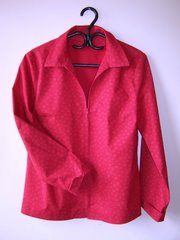
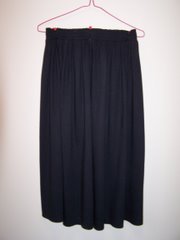
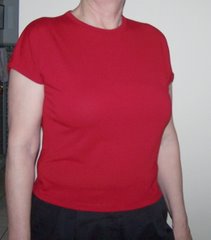
I have done a bit of sewing in the past month: made the silk noile skirt with a horrible-to-handle habutai bias lining that still awaits hemming; also I am in the middle of a pink denim A-line skirt, still needing hem and buttons down the front; I finished a Hot Patterns Pussycat blouse that was cut out before Steve passed away. It was an interesting challenge, but I messed up on the fitting of the sleeve somehow, so it is not terribly comfortable. (I think I allowed some extra width in the bodice and didnt allow it in the sleeve. Something at the cutting stage got forgotten in the intervening weeks.) I also finished a couple of other UFO shirts. Nothing has been overly satisfying, however....I think that's just the space I am in.
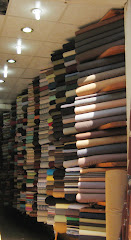
I am leaving on Monday with my sister and a friend for a trip to Egypt. Most of my sewing and wardrobe planning have been devoted to that, but the wardrobe has not come together well. You'd think after SWAP I would be able to plan 2 weeks worth of clothes, but it didn't happen. The trip was conceived several months ago, but all the planning had to be done in December and January. I didn't really need the extra stress, but I think the time away will make it worthwhile. My daughter lives in Cairo, and I have been there once before. I'm actually getting very excited in spite of the wardrobe crisis, and it sure will be nice to get away from all this SNOW and into some predictable sunshine. You can be sure that visiting the fabric markets is high on the "To Do" list. I'll be blogging when I can about the trip at http://bfleet.wordpress.com
Thank you so much for your interest. I am amazed at the "reality" of the online community, even though I do not participate very much. I hope all is well with you,and others who have extended their thoughts and prayers to us.
Happy sewing to all.
Betty
Sunday, February 10, 2008

Saturday, January 12, 2008
Thank you all for your kind comments
Since my last post, I have finally started to sew again, a silk noile skirt for an upcoming trip to Egypt. It's going slowly, when I feel in the mood, but I am back to problem-solving -- bias skirt, should the lining be bias also?
This is a good sign that I am on the way to returning to my normal energy level. I would like to thank those who took the trouble to send a few sentences of support. It feels like you are all good friends; most certainly you are all of a good heart, and your words have been so well-chosen and appropriate. Thank you so much, each one.
Betty.
This is a good sign that I am on the way to returning to my normal energy level. I would like to thank those who took the trouble to send a few sentences of support. It feels like you are all good friends; most certainly you are all of a good heart, and your words have been so well-chosen and appropriate. Thank you so much, each one.
Betty.
Sunday, December 30, 2007
Laying Low
I appreciate that some of you still visit my blog, and may be wondering why nothing has been posted lately. Sadly, we lost our son, aged 31, on Nov 27, 2007 due to complications of surgery. Nothing has quite got back to normal since then...most especially my sewing passion.
Hopefully, once the holiday season is past and we can try to move on to another definition of "normal" I will get back to my machines and my various projects. Until then, thanks for your interest in my musings.
Betty
Hopefully, once the holiday season is past and we can try to move on to another definition of "normal" I will get back to my machines and my various projects. Until then, thanks for your interest in my musings.
Betty
Saturday, October 20, 2007
ThisWeek
 This beautiful fall weather has interfered with my sewing week. I actually got a sunburn sitting on the deck one afternoon. Today it is raining. We had a wild weather night, and one of my carefully piled woodpiles fell totally over in the wind. I guess wood-piling is not my strong suit.
T-shirts: Yesterday I managed to finish the two Jalie T-shirts and a skirt that had been waiting for hems. Knits still elude me, and the fit on these Jalie shirts is not perfect. I blogged about these fitting issues earlier.
Knit skirt: The skirt looks ok, but it has a wide (3.5" or more) contoured waistband at the top which I have decided is not flattering on me. The T-shirt stops about an inch above the band, drawing attention to the 'line' created near the hips. Still, it's nice to have a shirt and top that are the same -- a dress in effect.
New Project: Earlier in the week I cut out a 'test pattern' for Simplicity 3789, a princess seamed shirt, the view with the cross over front.

This is my first Simplicity B-C-D pattern. The fabric is from my stash, and is an ivory pashmina-type fabric whose composition I forget -- includes some rayon I think. I washed it, even though it says dry clean only. It's very soft, but seems to cling to itself, and will be a pain to work with as it tends to stretch every which-way. I spent a long time with the pattern making the required adjustments, hoping to turn this into a TNT shirt pattern, as there are several styles in the envelope. Mostly I just want to check the fit.
 Donna Karan Cape: My package from "The Sewing Place" came with the grosgrain I ordered for the Donna Karan cape. The color is not a perfect blend, and I am still on the fence about using it. Originally I thought navy would be best, but then figured it was too much contrast, so I ordered a burgundy color that I hoped would work. I need to consult someone with a better color sense than mine. At the moment I am leaning toward omitting the grosgrain completely. I still have not solved the problem of the arm opening, but I spent quite awhile experimenting with various options. I think I need to make this decision and get on with it.
Decision Made: I consulted with my husband, who has a great eye for color, and the grosgrain simply won't do. It has an orange cast to it, whereas the fuchsia wool has a definite blue cast. Navy ribbon looks great with it, so now my decision is whether to re-order grosgrain and wait for another 10 days to get it, or to forget the grosgrain completely. I guess my decision is NOT made after all.
Sunday, October 14, 2007
Reflections on a Sewing Plan #2
Speaking of reflections:

The last post has generated a bit of interest, so I thought I should round it out with a couple of previous points that have come to me since I started sewing again. In the past year-and-a-half I've learned and re-learned a mountain of stuff, and have tried to make planning part of my sewing passion.....not altogether successfully, I might add.
The following points, however I hope I have taken to heart:
Reflection #6: Stifle thyself. There will always be more fabric. There will always be another sale. I remember vividly my first visit to Fabricville after at least 20 years of not sewing. I was overwhelmed by the selection, and afraid the sale would end before I could make up my mind. At the same time, it hit me that all this variety, in its continuous seasonal rotations, had been here for the past 20 years while I was away. Even though I cannot resist sometimes, I now tend to wait a bit before I rush into a purchase with no immediate purpose.
Reflection #7: If you must stash, stash wearable colors. I am a "winter" by complexion, and I love bright colors. In the fabric shop, however, I tend to neutrals, which are safe and flexible, but which don't make the most of my coloring. Neutrals will always be available, but my favorite bright royal blue may not. The current fashion season seems to be very neutral. I wish I had some stashed prints in jewel tones. Even prints with the bright fuchsia's and turquoises that I am looking for also feature beige, yellow or orange, all of which make me look awful.
Reflection #7B: Don't buy orphans. This means a great piece of fabric must sometimes acquire a companion before leaving the store....unless it already has one waiting patiently in the 3rd suitcase under the spare bed. Mostly this idea just slows down the fabric addiction chemicals in the brain to a point where logic can prevail once more.
Orphans that other people give you are ok. You can use them as an excuse to go shopping for siblings for them.

The last post has generated a bit of interest, so I thought I should round it out with a couple of previous points that have come to me since I started sewing again. In the past year-and-a-half I've learned and re-learned a mountain of stuff, and have tried to make planning part of my sewing passion.....not altogether successfully, I might add.
The following points, however I hope I have taken to heart:
Reflection #6: Stifle thyself. There will always be more fabric. There will always be another sale. I remember vividly my first visit to Fabricville after at least 20 years of not sewing. I was overwhelmed by the selection, and afraid the sale would end before I could make up my mind. At the same time, it hit me that all this variety, in its continuous seasonal rotations, had been here for the past 20 years while I was away. Even though I cannot resist sometimes, I now tend to wait a bit before I rush into a purchase with no immediate purpose.
Reflection #7: If you must stash, stash wearable colors. I am a "winter" by complexion, and I love bright colors. In the fabric shop, however, I tend to neutrals, which are safe and flexible, but which don't make the most of my coloring. Neutrals will always be available, but my favorite bright royal blue may not. The current fashion season seems to be very neutral. I wish I had some stashed prints in jewel tones. Even prints with the bright fuchsia's and turquoises that I am looking for also feature beige, yellow or orange, all of which make me look awful.
Reflection #7B: Don't buy orphans. This means a great piece of fabric must sometimes acquire a companion before leaving the store....unless it already has one waiting patiently in the 3rd suitcase under the spare bed. Mostly this idea just slows down the fabric addiction chemicals in the brain to a point where logic can prevail once more.
Orphans that other people give you are ok. You can use them as an excuse to go shopping for siblings for them.
Friday, October 12, 2007
Reflections on a Sewing Plan
Today I read a post about layering on Marcy Tilton's website. Three garments were suggested whose necklines fit together so that a shirt, vest, and jacket could be worn on top of one another (and presumably removed as temperatures dictate.) I've never been much for layering other than bringing a sweater if I think it's going to be cool, such as in air conditioned restaurants when traveling in the summer heat.

It's fall here now, and raining today. We heat our house with wood, and the fire has been on all night and all day for the first time this year. It's very hot in here, and I started my day in a long-sleeved t-shirt, a treasured gift from a friend who lives far away.
As I prepared supper, and sat later in front of the stove, I realized that a long-sleeved shirt is not routine apparel for me in the winter...at least not when I am at home. Then I realized that of all the shirts I have made in the past year or so, most have been long sleeved. I've only worn them when going out, or in the case of cotton shirts, as an over-shirt for cool days or unknown weather conditions.
Reflective Lesson #1: Sew what you will wear. Since I am home much of the time, I should sew what I will wear around the house, ie: short sleeved shirts, sleeveless shirts and tank tops.
Reflective Lesson #2: Think of layering. I should choose patterns that can be worn over the shirts above, as you would wear a sweater. Long sleeves with uncomplicated necklines and coordinating colors. There's a bit of opportunity here for some neat styles, and embellishments.
Referring back to Lesson #1, I think we all spend more time sewing what we won't wear much than what we will wear often. The challenge of more complex garments I suppose is a factor. Having made the Burda Cape/jacket, and I am considering making another. Does a person need more than one of these, especially when she is also making another cape by Vogue? A cape has a life-span of what? -- 3 years maybe, before the fashion police snatch it away.
More than one person has suggested red wool crepe would make a fabulous version of the Burda Cape. My sister, who is much more practical thinks one is enough...but then, she does not wear red.
 As I was reflecting on all of this, I was stretching my legs and feeling glad I had on my taupe stretch cords, made for SWAP last year. Suddenly, it occurred to me that I really love these pants, and also the brown ones I bought from Northern Reflections, and will probably also love the green ones waiting for hems and a 5-lb weight loss:
 Reflective Lesson #3: Sew what you will wear. I like stretch cords. Therefore, make more. I could/should make them in every pattern and color I can find. Make them in NAVY for heaven's sake. My potential SWAP has a navy base -- make it work. Good grief, if I can find the fabric, I could make them in fuchsia and see if I have the nerve to wear them. Other stretch fabrics might be just as great!
 Yesterday and today I worked on 2 Jalie T-shirts, trying to get the pattern adjusted for a good fit. Knits frustrate me, and I mostly still don't get them right. On the first round, the fit was tight because the fabric did not have quite enough stretch. I knew that would be the case, but figured my daughter could wear it. It was the sleeves that surprised me....so high, and so tight,...and so uncomfortable.
Rather than give up in despair (after I had already made copious notes about what to change on the shoulders and bustline) I impulsively chopped off the sleeves very short. Well! Now the shirt fits half-decently, the shoulders are not off nearly as much as I thought, and if I make that 5-lb weight loss, my daughter will not be getting a new shirt.
I enlarged the sleeves and lowered the armholes on the pattern by using the armscye of a larger size. It was moderately successful, but the forward shoulder adjustment still results in a strangely twisted sleeve. If you are still with me, I am getting to my reflection. It happened when I came upstairs to get out of the long sleeved too-hot shirt. An old black T-shirt from Reitman's was on the bed, and I put it on. It is made with a ribbed knit, a bit stretchier than the fabrics I have been using, but it fits perfectly -- even in the shoulders -- which is saying a lot because my shoulder seams are always too far back.
Reflective Lesson #4: If you have an old perfectly fitting shirt, take a pattern off it instead of fighting with alterations on other people's patterns. Duh.
Reitman's still carries this fabric and style of shirt, but they have changed their sizing, or perhaps the stretchiness of the fabric has changed. I have several of the old version. Best get to work tracing them off.
I should never have accumulated a stash. Now it takes forever weighing options about what to do with this or that. I read a post by Kathryn showing a princess style dupioni shirt. I decided to use my green dupioni for a similar pattern......decisions: short sleeve or long? muslin first or not? Is this really what I want for this dupioni? OK. Better make a muslin since you will have to do some alterations for sure, even though this is a Simplicity B-C-D cup pattern. Around we go again. What to use for the muslin? Junk fabric, decent cotton -- what will go with the potential SWAP. This is nice, but there are 2 whole meters. Never mind, use it anyway. Do I really want a short-sleeved shirt from this beautiful Asian cotton?........around and around.
Reflective Lesson #5: Sometimes you have to just do it. I muddle too much. There are no right answers, maybe not even any best answers. Pick a fabric. Pick a pattern.
Reflective Lesson #5A: If there is something #5 will go with, made or unmade, carry on. Use crappy stuff for a minimal fitting muslin and quickly get on with the fashion fabric that you really want to work with.
So there you have it, a rainy day's ramblings, and maybe some focus to very unstructured sewing of late. I hope this helps my progress.

It's fall here now, and raining today. We heat our house with wood, and the fire has been on all night and all day for the first time this year. It's very hot in here, and I started my day in a long-sleeved t-shirt, a treasured gift from a friend who lives far away.
As I prepared supper, and sat later in front of the stove, I realized that a long-sleeved shirt is not routine apparel for me in the winter...at least not when I am at home. Then I realized that of all the shirts I have made in the past year or so, most have been long sleeved. I've only worn them when going out, or in the case of cotton shirts, as an over-shirt for cool days or unknown weather conditions.
Reflective Lesson #1: Sew what you will wear. Since I am home much of the time, I should sew what I will wear around the house, ie: short sleeved shirts, sleeveless shirts and tank tops.
Reflective Lesson #2: Think of layering. I should choose patterns that can be worn over the shirts above, as you would wear a sweater. Long sleeves with uncomplicated necklines and coordinating colors. There's a bit of opportunity here for some neat styles, and embellishments.
Referring back to Lesson #1, I think we all spend more time sewing what we won't wear much than what we will wear often. The challenge of more complex garments I suppose is a factor. Having made the Burda Cape/jacket, and I am considering making another. Does a person need more than one of these, especially when she is also making another cape by Vogue? A cape has a life-span of what? -- 3 years maybe, before the fashion police snatch it away.
More than one person has suggested red wool crepe would make a fabulous version of the Burda Cape. My sister, who is much more practical thinks one is enough...but then, she does not wear red.
 As I was reflecting on all of this, I was stretching my legs and feeling glad I had on my taupe stretch cords, made for SWAP last year. Suddenly, it occurred to me that I really love these pants, and also the brown ones I bought from Northern Reflections, and will probably also love the green ones waiting for hems and a 5-lb weight loss:
 Reflective Lesson #3: Sew what you will wear. I like stretch cords. Therefore, make more. I could/should make them in every pattern and color I can find. Make them in NAVY for heaven's sake. My potential SWAP has a navy base -- make it work. Good grief, if I can find the fabric, I could make them in fuchsia and see if I have the nerve to wear them. Other stretch fabrics might be just as great!
 Yesterday and today I worked on 2 Jalie T-shirts, trying to get the pattern adjusted for a good fit. Knits frustrate me, and I mostly still don't get them right. On the first round, the fit was tight because the fabric did not have quite enough stretch. I knew that would be the case, but figured my daughter could wear it. It was the sleeves that surprised me....so high, and so tight,...and so uncomfortable.
Rather than give up in despair (after I had already made copious notes about what to change on the shoulders and bustline) I impulsively chopped off the sleeves very short. Well! Now the shirt fits half-decently, the shoulders are not off nearly as much as I thought, and if I make that 5-lb weight loss, my daughter will not be getting a new shirt.
I enlarged the sleeves and lowered the armholes on the pattern by using the armscye of a larger size. It was moderately successful, but the forward shoulder adjustment still results in a strangely twisted sleeve. If you are still with me, I am getting to my reflection. It happened when I came upstairs to get out of the long sleeved too-hot shirt. An old black T-shirt from Reitman's was on the bed, and I put it on. It is made with a ribbed knit, a bit stretchier than the fabrics I have been using, but it fits perfectly -- even in the shoulders -- which is saying a lot because my shoulder seams are always too far back.
Reflective Lesson #4: If you have an old perfectly fitting shirt, take a pattern off it instead of fighting with alterations on other people's patterns. Duh.
Reitman's still carries this fabric and style of shirt, but they have changed their sizing, or perhaps the stretchiness of the fabric has changed. I have several of the old version. Best get to work tracing them off.
I should never have accumulated a stash. Now it takes forever weighing options about what to do with this or that. I read a post by Kathryn showing a princess style dupioni shirt. I decided to use my green dupioni for a similar pattern......decisions: short sleeve or long? muslin first or not? Is this really what I want for this dupioni? OK. Better make a muslin since you will have to do some alterations for sure, even though this is a Simplicity B-C-D cup pattern. Around we go again. What to use for the muslin? Junk fabric, decent cotton -- what will go with the potential SWAP. This is nice, but there are 2 whole meters. Never mind, use it anyway. Do I really want a short-sleeved shirt from this beautiful Asian cotton?........around and around.
Reflective Lesson #5: Sometimes you have to just do it. I muddle too much. There are no right answers, maybe not even any best answers. Pick a fabric. Pick a pattern.
Reflective Lesson #5A: If there is something #5 will go with, made or unmade, carry on. Use crappy stuff for a minimal fitting muslin and quickly get on with the fashion fabric that you really want to work with.
So there you have it, a rainy day's ramblings, and maybe some focus to very unstructured sewing of late. I hope this helps my progress.
Tuesday, October 9, 2007
Jacket/Cape - Burda WOF - Aug 07, #111B
A late-summer sewing splurge found me enchanted with the cape/vest from the August Burda WOF. It's a very avant-garde fashion statement for me, but needed a change and a challenge.
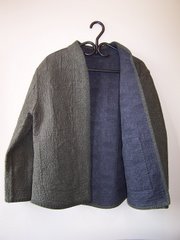
The picture below shows the result, though I can now see it needs a good pressing!!
 My original intention was to make the jacket from red wool crepe, purchased for last year's SWAP, but never used. This green one was supposed to be a wearable muslin, to check out the sizing, then it became a major project in itself.
This garment was fun to sew, but has a bazillion little details that can be a thrill or a pain. The underlying vest is very comfortable, and suggests being used as the base for a jacket, adding sleeves from another pattern.
Process: I traced and pin-fit the pattern, and decided to sew it without any alterations. Usually I would lower the bust and lengthen the torso, but the bust seemed to fit well (besides, it's essentially behind the cape, isn't it?) and I was not too sure about how to lengthen the curved pieces of the cape. In retrospect, I should have stifled my urge to get going and thought this problem through.
So off I went, working with a piece of green faux suede, also bought for my last SWAP and not used. I only had about 1.5m of this stuff, not enough to make the unlined version with wide front facings, so I made the lined option, using a length of quilting cotton I had bought for a shirt. I decided it was too heavy for a comfortable shirt, but it had the exact green in it to match the Fashion Fabric. Killing two stash pieces in one fell swoop!
 The faux suede, which I had not sewn with before, was wonderful to work with, and of course, the cotton was no problem.
The Design: The pattern is essentially a princess seamed vest and the cape portion is seamed into the princess seam at the front.
No project would be complete without a litany of lessons learned and errors made:
The picture below shows the result, though I can now see it needs a good pressing!!
 My original intention was to make the jacket from red wool crepe, purchased for last year's SWAP, but never used. This green one was supposed to be a wearable muslin, to check out the sizing, then it became a major project in itself.
This garment was fun to sew, but has a bazillion little details that can be a thrill or a pain. The underlying vest is very comfortable, and suggests being used as the base for a jacket, adding sleeves from another pattern.
Process: I traced and pin-fit the pattern, and decided to sew it without any alterations. Usually I would lower the bust and lengthen the torso, but the bust seemed to fit well (besides, it's essentially behind the cape, isn't it?) and I was not too sure about how to lengthen the curved pieces of the cape. In retrospect, I should have stifled my urge to get going and thought this problem through.
So off I went, working with a piece of green faux suede, also bought for my last SWAP and not used. I only had about 1.5m of this stuff, not enough to make the unlined version with wide front facings, so I made the lined option, using a length of quilting cotton I had bought for a shirt. I decided it was too heavy for a comfortable shirt, but it had the exact green in it to match the Fashion Fabric. Killing two stash pieces in one fell swoop!
 The faux suede, which I had not sewn with before, was wonderful to work with, and of course, the cotton was no problem.
The Design: The pattern is essentially a princess seamed vest and the cape portion is seamed into the princess seam at the front.
No project would be complete without a litany of lessons learned and errors made:
- Being long-waisted, I really should have lengthened the whole thing. The belt is designed to come round slightly above the waist, and for me it is several inches above, so not all that comfortable. Lengthening the cape would required some thought, as a drop of 2" would increase the circumference quite a bit. It would be necessary to decide whether to do that, or to change the curve.
- Speaking of the belt: I made it too short (one should always actually measure the part around which the belt goes, then add for what will extend through the buckle). I also used a stiff woven interfacing in the belt. Not sure it was the best idea. I ended up having to add a piece to the center of the belt so it is not a fashion statement in any way. Fortunately it is not visible as it sits under the cape back. Nevertheless, a new belt is in order. Unfortunately, I do not have any fabric left. Every scrap was used.
- There is a lot of topstitching, and for the bit around the hem (the lining is seamed at the edge of the hemline) it might have been wise to baste rather than pin, or use a fusible tape to keep one layer from creeping more than the other around the curve. Since all the topstitching is not done at the same time, keeping track of stitch lengths and width from edge, and thread color is important.
- Working carefully: At the front where the cape joins the front pieces there is a very short of seaming below the slit for the belt. So there is absolutely no room for error in the hem or the placement of the belt slit. Personally, I would have left a bit more there for safety's sake. I had to pick out some stitching there and raise the belt slit a bit to make everything come out neatly. The belt slit starts exactly at the topstitching line around the hem edge. I am not sure what happens here if in the unlined version where the hem is turned up, but you have to leave room for it.
- There are a number of places in this construction where the mind has to conceive things inside out, upside down and backwards. My mind does not do this well. In particular, getting the lining installed was laughable as I struggled to figure out where to sew, what sides together, etc. I believe this is called "bagging" a lining, where the lining is constructed separately from the garment then all sewed in together, turned inside out by hauling through a shoulder seam or someplace equally narrow and inaccessible. There was a lot of scrunching up during this process, but it came out well in the end.
One thing I did right was to leave the final lining seam open until I was sure everything else was properly placed and I did not have to get back inside for anything. (In fact, the final side seam is still open, as I forgot to sew it up when doing the final touches today.) - Interfacing: Without pretesting on a scrap, I interfaced the collar, epaulets and pocket welts with a lightweight woven fusible. The result was pieces that resembled cardboard in their flexibility. (This was part but by no means the most critical factor in ruining the collar.) I was able to redo the shoulder decorations with a thin knit interfacing that left some movement. Otherwise they would not have bent enough to sew them down. I used the welts as they were since they did not require any movement once in place. (You must remember here that I was seriously out of fabric at this point.)
- I ruined the collar at the beginning. No need to go into details, just not paying attention and also using a too-stiff interfacing. I did not have enough fabric to make another, so my collar now matches the lining. This is not a particularly bad thing, just annoying.
- The neckline where the collar attaches is bulky. Both vest and cape join at the collar, so there is a lot of bulk there to deal with. This is in part due to the bulk of the chosen fabrics and collar interfacing. In another incarnation, I would be more careful about clipping and really ponder over the construction methods and fabric choices to try to reduce this.
- Lining with cotton: I chose the cotton lining for its color match to the suede. It is a bit heavy and un-slippery for a lining. I made this choice when I was still viewing this an an experimental garment. For best effect, I think this jacket should be made with collar and lapels made of the main fashion fabric. On the other hand, the cotton adds warmth, and it certainly adds an interesting element to the design.
- I messed up the buttonholes: Buttonholes are not my strong suit. This front has 6 large buttons in a double-breasted style. There are some other little details around the button layout, but I was again not as careful as necessary and misplaced the center buttonhole by 1/4", leaving insufficient space for equally spaced buttons at the top. Though I do not expect to wear this garment with the top closed up to the neck, it would have been nice to have done it right. I need to get over my fear of getting the buttonholes looking good and properly placed. Practice. Practice. Practice.
Subscribe to:
Posts (Atom)